
Project Tomorrow vs The Planet Crafter: Compared
A fair comparison of Project Tomorrow and The Planet Crafter: terraforming, combat, perspective, content and price, and which game fits your playstyle.
Both games are about terraforming a dead world, but they are different genres. The Planet Crafter is a peaceful first-person survival builder; Project Tomorrow is a top-down base builder with wave defense. If you want combat pressure, Project Tomorrow is the closer fit. Source: Project Tomorrow on Steam ↗
The comparison is natural: two games about turning a hostile planet green. The difference is what happens while you do it. The Planet Crafter asks you to survive the environment; Project Tomorrow asks you to survive the environment and the things living in it.
This comparison is based on the games' store pages and the Project Tomorrow demo. It avoids claiming exact playtimes for either.
The short version
- The Planet Crafter — first-person, peaceful, exploration and automation, no combat. A builder for players who want a calm project.
- Project Tomorrow — top-down, hex-grid base building, terraforming plus wave defense, three regions, Early Access. A builder for players who want pressure.
If you want to terraform without being attacked, The Planet Crafter is the obvious choice. If you want the terraforming to be contested, Project Tomorrow is the one.
Side by side
| Project Tomorrow | The Planet Crafter | |
|---|---|---|
| Perspective | Top-down | First-person |
| Genre | Base building + survival + tower defense | Survival + terraforming + exploration |
| Combat | Yes, wave defense | No direct combat |
| Terraforming | Emitters, infusers, drills; adjacency bonus | Global terraforming stages |
| Base building | Hex grid, walls, turrets | Modular base pieces |
| Multiplayer | Single-player | Co-op |
| Content model | Early Access, three regions | Released, expanding |
| Price | $5.94 at the time of writing | Higher; check the store |
The table is the honest summary. The rest of this page explains why each difference matters.
Terraforming: system vs spectacle
The Planet Crafter's terraforming is a global progression. You build machines, the planet's atmosphere and temperature rise, and the world changes around you. The spectacle is the point: the sky colors shift, water appears, plants grow.
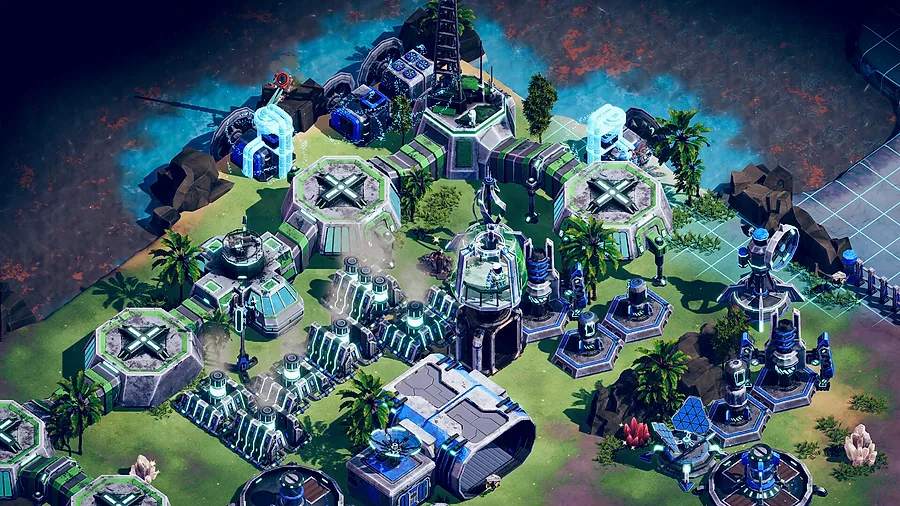
Project Tomorrow's terraforming is more granular. You place Oxygen Emitters, Hydro Infusers and Thermal Drills on a hex grid, and they create local green zones. Adjacent machines stack a bonus. The map changes in patches rather than all at once, and the patches are where you can safely walk.
Which is better depends on what you want. The Planet Crafter gives you a planet-scale transformation; Project Tomorrow gives you a tactical footprint. Project Tomorrow's system is also tied to the wave loop: every machine is a target, and every build advances the next attack.
Combat: the dividing line
This is the biggest difference. The Planet Crafter is a peaceful game. Project Tomorrow is not. Its waves attack the base, target the terraforming machines and force you to build walls and turrets.
If you play The Planet Crafter for relaxation, Project Tomorrow's timer may feel like interruption. If you play The Planet Crafter and wish the planet fought back, Project Tomorrow is the answer.
The combat is base defense, not action combat. You place turrets, man a Watchtower and finish stragglers. It is closer to a tower defense game than to a shooter.
Perspective and scale
The Planet Crafter's first-person view makes the terraforming feel personal: you walk through the world you changed. Project Tomorrow's top-down view makes the base legible: you see the grid, the coverage, the lanes and the breach.
Top-down is better for defense planning. First-person is better for immersion. Neither is objectively superior; they serve different fantasies.
Content and price
Project Tomorrow is in Early Access with three regions, 20 buildings, 75 items, 18 enemy types and 20 modifiers. It costs $5.94 at the time of writing, which is low for the genre.
The Planet Crafter is a released game with a longer content tail and co-op. It costs more. If you are choosing on content per dollar, check both store pages for current prices and playtimes; the numbers change with sales.
Project Tomorrow's Early Access status matters. The developer plans more regions, buildings, enemies and gameplay. The current three regions are the content you can play today.
Who should pick Project Tomorrow?
- You want base defense with your terraforming.
- You like hex-grid layouts and turret coverage.
- You want a short, cheap campaign you can replay with modifiers.
- You are comfortable with Early Access.
Who should pick The Planet Crafter?
- You want a peaceful builder with no combat.
- You want first-person exploration and a planet-scale transformation.
- You want co-op.
- You want a released game with a longer content tail.
Can you play both?
Yes. They scratch different itches. Project Tomorrow is the one for a defensive, systems-heavy evening; The Planet Crafter is the one for a calm exploration session.
What about Riftbreaker?
Riftbreaker is the other common comparison: base building plus tower defense plus action combat. It is faster and more action-oriented than Project Tomorrow, with a larger tech tree. Project Tomorrow is slower, cheaper and more focused on terraforming. If you want twin-stick action, Riftbreaker; if you want a compact base builder, Project Tomorrow.
The review→ covers Project Tomorrow on its own terms. The beginner guide→ shows what the first hour looks like.
FAQ
Is Project Tomorrow like The Planet Crafter?
Both are terraforming games, but Project Tomorrow is a top-down base builder with wave defense, while The Planet Crafter is a peaceful first-person survival builder.
Does Project Tomorrow have combat?
Yes. Waves of enemies attack the base and the terraforming machines. Defense is a core system.
Is The Planet Crafter multiplayer?
Yes, it has co-op. Project Tomorrow is single-player.
Which is cheaper?
Project Tomorrow was $5.94 at the time of writing. Check both store pages for current prices.
Sources
Official source: Project Tomorrow on Steam ↗ Project Tomorrow guides and walkthroughs