
Project Tomorrow Enemies: Flying, Heavy and Swarm Types
A field guide to Project Tomorrow enemies: ground swarms, flying units that ignore walls, armored Guardians in Winterbloom and the nests that spawn them.
Project Tomorrow launched with 18 enemy types. The three categories that change your defense are ground swarms, flying units that bypass walls, and the armored Guardians of Winterbloom. Alien nests spawn enemies and can attack the base. Source: Project Tomorrow Steam news ↗
Knowing the enemy is half of base defense. The other half is placing a turret that can actually hit it. This guide groups Project Tomorrow's enemies by the problem they create, not by name, because the names of most of the 18 types are not documented yet.
If you only remember one thing: walls stop ground, they do not stop air, and heavy units are why you build a Gauss Cannon.
The four categories
1. Light ground
Small, fast, numerous. They are the default wave filler and the reason a Pulse Turret pays for itself. Individually weak, dangerous in a group because they surround turrets and slip through a breach.
Counter: Pulse Turrets at the gate, overlapping arcs, and a wall that forces them into the kill zone. Your personal weapon is good for cleaning up stragglers.
2. Armored ground
Slow, high health, high damage. They open a wall so the light units can pour through. In Winterbloom the heavy type is the Guardian: heavily armored, high health and area damage.
Counter: Gauss Cannon behind the wall, a second wall line, and focus fire. Do not meet a heavy unit in the open with a Pulse Pistol.
3. Flying
Flying enemies ignore walls and head for the base's interior. They are the reason Tidehaven and Winterbloom need Interceptors. They often target defenses and production rather than the wall itself.
Counter: Interceptor turrets near the inner ring, personal fire, and a Watchtower for range. Ground-only turrets are wasted against them.
4. Nests
Nests are structures, not units. They spawn enemies and can attack the base. A nest near your expansion route is a problem you must solve before you build there.
Counter: clear the nest with a prepared force, not during a wave. Do not build a forward outpost next to a nest.
Flying enemies change the map
The Tidehaven patch notes are explicit: flying enemies can cross walls and attack your defenses. That single rule invalidates the "wall the perimeter and forget it" approach.
Practical consequences:
- Air coverage belongs in the inner ring. A flyer that crosses the outer wall is already inside; an Interceptor at the gate may never get a shot.
- Housing and terraforming need air cover. Those are the buildings flyers reach first.
- The Watchtower matters more in air regions. The range and fire-rate boost helps your personal weapon track flyers.
- Do not overbuild ground turrets. A base with six Pulse Turrets and no Interceptor loses to an air wave.
The turrets guide→ covers the Interceptor's placement in detail.
Guardians and Winterbloom
Winterbloom is the third region and the difficulty spike. Its signature enemy, the Guardian, is heavily armored with high health and area damage. The patch notes describe the region's frontline as strong but exposed to flying enemies, which is why Winterbloom needs both a ground hammer and air support.
How to handle a Guardian push:
- Meet it behind the wall, not at the wall. The wall absorbs the first hit; the Gauss Cannon does the damage.
- Keep the turret repaired. A Guardian's area damage can hit multiple buildings.
- Layer the defense. If the outer line falls, the mid line should already be firing.
- Do not ignore the flyers while the Guardian is on screen. The air wave often arrives with the ground push.
- Accept a wall loss. Rebuilding a wall is cheaper than losing the Gauss Cannon.
The Winterbloom guide→ covers the region's full enemy mix.
How to read a wave
Before the wave lands, look at:
- The announced direction. Suncrest announces one; later regions use multiple lanes.
- The composition preview. If the wave includes air, move to the inner ring.
- The target. Aliens prioritize terraforming machines, then defenses, then walls.
- The timer. A wave that arrives while you are far from base is a wave you fight alone.
Do not try to identify every enemy name in the middle of a fight. Identify the category: ground, air, heavy, nest. The category tells you which turret should be firing.
Target priority for the player
Your turrets handle the bulk. Your personal weapon should focus on:
- Flyers heading for the terraforming cluster.
- Heavies that have broken through the gate.
- Light units inside the wall.
- Stragglers at the wall.
Do not chase a single enemy across the map. The wave is won at the kill zone.
Region differences
Suncrest: light ground, one attack direction, no air pressure in the opening. A Pulse Turret and a wall are enough.
Tidehaven: multiple lanes, flying enemies, automated production. Interceptors become mandatory, and the defense splits into two kill zones.
Winterbloom: Guardians, heavy armor, air, and a longer front. Gauss Cannons, Nova Mortars and layered walls.
The walkthrough→ puts the regions in order, and the region guides→ cover their specific threats.
Common enemy mistakes
Building only ground turrets. Air waves will walk through.
Fighting a Guardian in the open. Use the wall and the Gauss Cannon.
Ignoring a nest. It keeps spawning until cleared.
Chasing enemies away from the base. The base is the objective.
Assuming the first region represents the game. Suncrest is a tutorial; Tidehaven and Winterbloom add air and armor.
Building a forward outpost next to a nest. It will not survive.
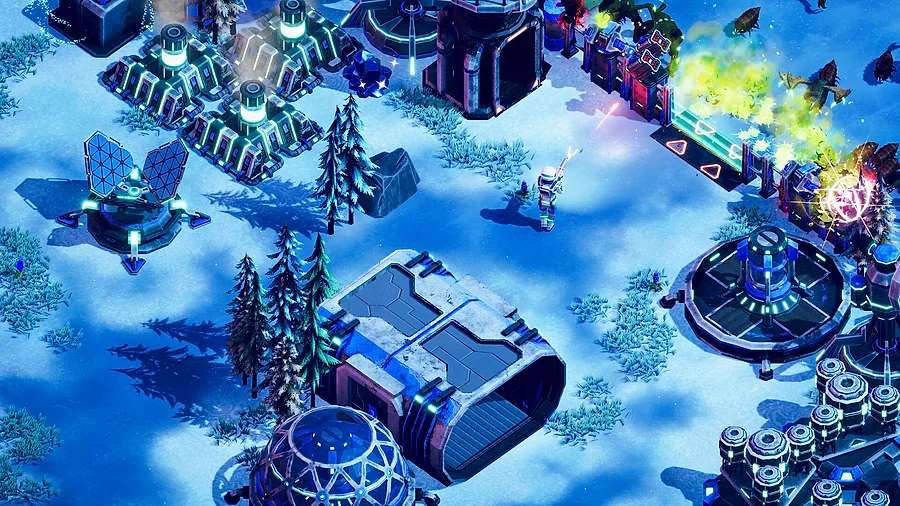
If a wave keeps breaking the same wall, the defense guide→ has the post-wave checklist. If you are choosing turrets, the turrets guide→ maps each enemy to a weapon.
FAQ
How many enemy types are in Project Tomorrow?
The Early Access launch includes 18 enemy types across three regions.
Do flying enemies ignore walls?
Yes. Tidehaven's patch notes explicitly say flying enemies can cross walls and attack defenses, which is why Interceptors exist.
What are Guardians?
Winterbloom's heavy enemy type: heavily armored, high health and area damage. They are the reason to build a Gauss Cannon and a layered wall.
Can nests be destroyed?
Yes. Clear them with a prepared force, outside a wave. Do not build next to one.
Sources
- Project Tomorrow on Steam ↗
- Project Tomorrow Steam news: Tidehaven ↗
- Project Tomorrow Steam news: Winterbloom ↗
- Wolfman Mazy demo gameplay ↗
Official source: Project Tomorrow on Steam ↗ Project Tomorrow guides and walkthroughs